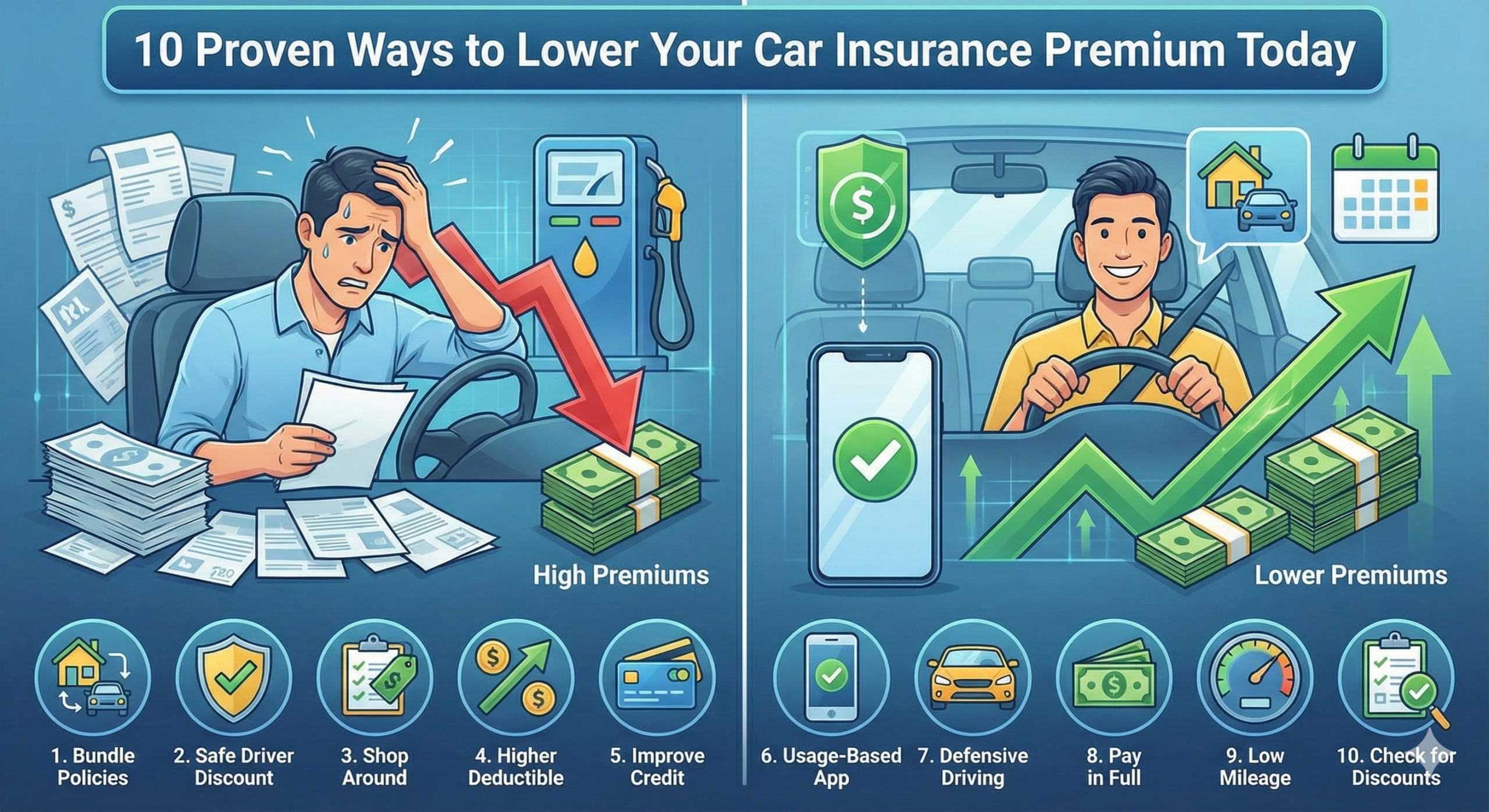
Is your car insurance bill eating up a larger chunk of your monthly budget than your actual car payment? You aren’t alone. With inflation driving up repair costs and extreme weather events impacting risk assessments, drivers across the country are seeing their rates climb. Industry reports project that premiums could rise by another 7% to 10% in the coming year, leaving many families scrambling for relief.
The good news is that you are not powerless against these rate hikes. While you cannot control global economics, you can control how insurers view your risk profile. Lowering your premium doesn’t necessarily mean sacrificing the quality of your coverage; it often means being smarter about how you buy it. From leveraging modern telematics technology to mastering the art of the “bundle,” there are strategic moves you can make right now to slash costs.
In this guide, we will walk you through 10 proven ways to lower your car insurance premium. We will dive deep into actionable strategies, provide real-world examples, and break down exactly how much you could save. Whether you are a new driver or have been on the road for decades, these tips are designed to put money back in your pocket today.
1. Master the Art of “Bundling” Your Policies
One of the fastest and most effective ways to drop your car insurance costs is to stop treating your policies as separate entities. Most major insurance carriers offer significant discounts—often referred to as “multi-line” discounts—if you purchase more than one type of insurance from them. The most common combination is bundling auto insurance with homeowners or renters insurance.
Why do insurers do this? It’s simple customer retention. A client who has their home, car, and boat insured with one company is far less likely to switch providers than someone with a single policy. Because of this, companies are willing to shave off a substantial portion of your premium. Data from major carriers suggests that bundling can save you anywhere from 5% to 25% on your total insurance bill.
Real-World Example:
Consider “Sarah,” a homeowner in Ohio. She was paying $1,200 annually for auto coverage with Company A and $900 for home insurance with Company B. By moving her auto policy to Company B, she triggered a 15% bundling discount on both policies. Her total savings amounted to over $300 a year, just for consolidating her paperwork.
Comparison: Bundled vs. Unbundled
* Unbundled: Auto ($1,200) + Home ($900) = $2,100/year.
* Bundled: Auto ($1,020) + Home ($765) = $1,785/year.
* Result: $315 annual savings.
For more on how housing impacts your finances, check out our guide on essential home maintenance tips to keep your property value high.
2. Switch to Usage-Based Insurance (Telematics)
If you are a safe driver, why are you paying the same rate as someone who speeds and brakes hard? Usage-based insurance (UBI), often powered by telematics, is revolutionizing the car insurance industry. This program involves installing a small device in your car or using a mobile app to track your driving habits. Insurers monitor data points like speed, hard braking, time of day driven, and mileage.
This is a high-reward strategy for cautious drivers. Many providers offer an immediate discount (often around 5-10%) just for signing up. After a monitoring period—usually six months—your rate is adjusted based on your actual performance. Safe drivers can see their premiums drop by as much as 30% to 40%. However, be aware that some aggressive programs might raise your rates if you drive recklessly, so this is best suited for those committed to safety.
Real-World Example:
John works from home and only drives to the grocery store and gym. He signed up for a telematics program with his insurer. Because he avoids rush hour traffic and rarely slams on his brakes, his insurer classified him as a “low-risk” driver. When his policy renewed, his premium dropped from $150/month to $105/month.
You can learn more about how telematics technology works at the Insurance Information Institute.
3. Shop Around and Compare Quotes Annually
Loyalty is a virtue in friendships, but in the car insurance market, it can be costly. Many drivers fall into the trap of “auto-renewal,” letting their policy roll over year after year without checking current market rates. Insurers often count on this inertia, sometimes inching up rates for long-term customers in a practice known as “price optimization.”
To ensure you are getting the best deal, you should compare car insurance quotes at least once a year or whenever you have a major life change (like moving, getting married, or buying a new car). Different insurers use different algorithms to determine risk. One company might heavily penalize a minor speeding ticket, while another might be more lenient. By shopping around, you force companies to compete for your business.
Real-World Example:
A driver in Florida had been with the same company for 10 years. After noticing a 12% hike in his renewal notice, he spent 30 minutes on a comparison site. He found that a competitor was offering the exact same coverage limits for $450 less per year. He switched immediately.
Comparison: The Cost of Loyalty
* Renewing Blindly: Premium increases by 5-10% annually regardless of driving record.
* Shopping Around: Potential to find “new customer” rates that are 15-20% lower than your current renewal offer.
4. Increase Your Deductible Strategically
Your deductible is the amount you pay out-of-pocket before your insurance coverage kicks in. A standard deductible is often $500. However, if you are willing to take on a bit more financial risk in the event of an accident, raising your deductible to $1,000 or even $2,000 can drastically lower your monthly car insurance premium.
The logic is straightforward: by agreeing to pay more upfront during a claim, you reduce the insurer’s financial exposure, and they pass those savings on to you. This strategy is most effective for drivers who have an emergency fund set aside. If you live paycheck to paycheck, a high deductible could be disastrous after an accident. But if you have savings, the monthly reduction is often worth it.
Real-World Example:
Lisa drives a 2018 sedan. Her quote with a $500 deductible was $1,400 a year. By raising her deductible to $1,000, her premium dropped to $1,150. That is a guaranteed savings of $250 every year. If she goes four years without an accident, she has saved $1,000—covering the cost of the deductible difference entirely.
For advice on building that emergency fund, read our guide on smart financial planning basics.
5. Improve Your Credit Score
It might seem unfair, but in most states, your credit score is a major factor in calculating your car insurance rate. Insurers use a metric called a “credit-based insurance score” to predict the likelihood of a driver filing a claim. Statistical data shows a correlation between lower credit scores and a higher frequency of claims.
Drivers with excellent credit can pay significantly less than those with poor credit—sometimes half as much. If your credit score is currently low, focus on paying down debt and making on-time payments. As your score improves, contact your insurer to ask for a re-evaluation of your premium. Some states (like California, Hawaii, and Massachusetts) prohibit this practice, so check your local laws.
Real-World Example:
Mark had a credit score of 580 and was paying heavily for liability coverage. Over two years, he paid off credit card debt and raised his score to 720. He called his agent, who re-ran his profile. The result was an immediate 20% drop in his auto insurance premium, saving him nearly $400 annually.
You can check your credit score for free at AnnualCreditReport.com.
6. Drive a “Low-Risk” Vehicle
Before you buy that flashy sports car or luxury SUV, consider how it will impact your insurance. Car insurance companies assign rates based on the vehicle’s value, safety ratings, theft frequency, and cost of repairs. A car that is expensive to repair or highly desired by thieves will always cost more to insure.
Generally, family sedans, minivans, and mid-sized SUVs with high safety ratings (like those from the IIHS) are the cheapest to insure. They are involved in fewer severe accidents and are cheaper to fix. Conversely, high-performance vehicles or cars with complex technology (like sensors in bumpers) can drive premiums up significantly.
Real-World Example:
A young driver is deciding between a used Honda CR-V and a used BMW 3 Series. The BMW requires specialized parts and labor, and it is statistically driven more aggressively. The insurance quote for the BMW is $2,200/year, while the CR-V is $1,400/year. Choosing the sensible car saves $800 annually.
Check safety ratings before you buy at the Insurance Institute for Highway Safety (IIHS).
7. Review and Drop Unnecessary Coverage
If you are driving an older vehicle, you might be paying for coverage you effectively cannot use. Comprehensive and collision coverage pays to repair your vehicle if it is damaged or stolen. However, the maximum payout is limited to the car’s current cash value. If your car is worth less than $3,000, paying $500+ a year for this coverage might not make financial sense.
A general rule of thumb is that if the annual cost of comprehensive and collision coverage exceeds 10% of your car’s value, it might be time to drop it and stick to liability coverage only. This protects you if you hit someone else, but you would be responsible for replacing your own car.
Real-World Example:
Tom drives a 2008 pickup truck worth about $2,500. He was paying $600 a year for full coverage. If he totaled the truck, the insurer would give him $2,500 minus his $500 deductible ($2,000 net). He realized he was paying $600 a year to protect a potential $2,000 payout. He dropped the coverage to save money.
Use tools like Kelley Blue Book to determine your car’s current market value.
8. Take Advantage of Low Mileage Discounts
The post-pandemic world has changed how we drive. If you work from home or have a short commute, you might qualify for a low-mileage discount. Car insurance companies operate on probability: the fewer miles you drive, the lower the probability of an accident.
Standard policies often assume you drive 12,000 miles a year (the national average). If you are actually driving 7,000 miles or less, you are overpaying. Call your agent and update your annual mileage. Some insurers offer specific tiers of discounts for driving under 5,000, 7,500, or 10,000 miles annually. This is different from telematics; it is simply a rating factor adjustment.
Comparison: Commuter vs. Remote Worker
* High Mileage (15k+ miles/year): Higher premium due to increased exposure to road risks.
* Low Mileage (<7k miles/year): Potential savings of 5-15% because the car sits in the driveway safely most of the time.
9. Pay Your Premium Annually
Insurance companies love cash flow. To encourage you to pay upfront, many offer a “paid-in-full” discount. If you pay your car insurance premium month-to-month, you are likely paying an administrative fee or “installment fee” for every payment processing. Over 12 months, these fees add up.
While paying $1,000 in one lump sum can be a shock to the wallet, it is often cheaper than paying $100 a month for 12 months ($1,200 total). The discount for paying in full can range from 5% to 10%, which is a better return on investment than most savings accounts offer.
Real-World Example:
Jennifer’s monthly premium was $155, which included a $5 monthly service fee. Her total yearly cost was $1,860. The insurer offered a paid-in-full option of $1,650. By paying upfront, she saved $210 instantly—essentially getting more than a month of free insurance.
For more on managing large expenses, see Investopedia’s tips on financial health.
10. The Ultimate Discount Checklist
Finally, never assume you are getting all the discounts you are entitled to. Insurers have dozens of discount codes, but agents might not apply them unless you ask. Before you renew your policy, go through this checklist with your agent to ensure you are maximizing your savings.
- Defensive Driving Course: Taking an accredited safety course can save you 5-10%.
- Good Student Discount: High school or college students with a ‘B’ average or better often qualify.
- Anti-Theft Devices: Installing alarms or GPS trackers can lower comprehensive premiums.
- Paperless Billing: A small but easy discount for receiving documents via email.
- Affinity Groups: Alumni associations, military service, or professional organizations (like engineers or teachers) often have group rates.
- Multi-Car Discount: Insuring two cars is usually cheaper per vehicle than insuring one.
Real-World Example:
A family with a teenage driver was facing a massive rate hike. They asked their agent about discounts and applied the “Good Student” discount (for the teen’s 3.5 GPA) and the “Defensive Driving” discount (after the teen took a weekend online course). These two changes alone saved them nearly 15%.
Conclusion: Take Action to Save Today
lowering your car insurance premium doesn’t require a miracle; it requires a proactive approach. By combining these strategies—bundling policies, embracing telematics, improving your credit, and regularly shopping for new car insurance quotes—you can shave hundreds, if not thousands, of dollars off your annual expenses.
Don’t let your policy auto-renew without a fight. Pick two or three of the tips above and implement them this week. Call your agent, check your deductible, or get a quote from a competitor. The savings are out there waiting for you.
Disclaimer: Insurance rates vary by state and individual circumstances. Always consult with a licensed insurance professional before making significant changes to your coverage limits.