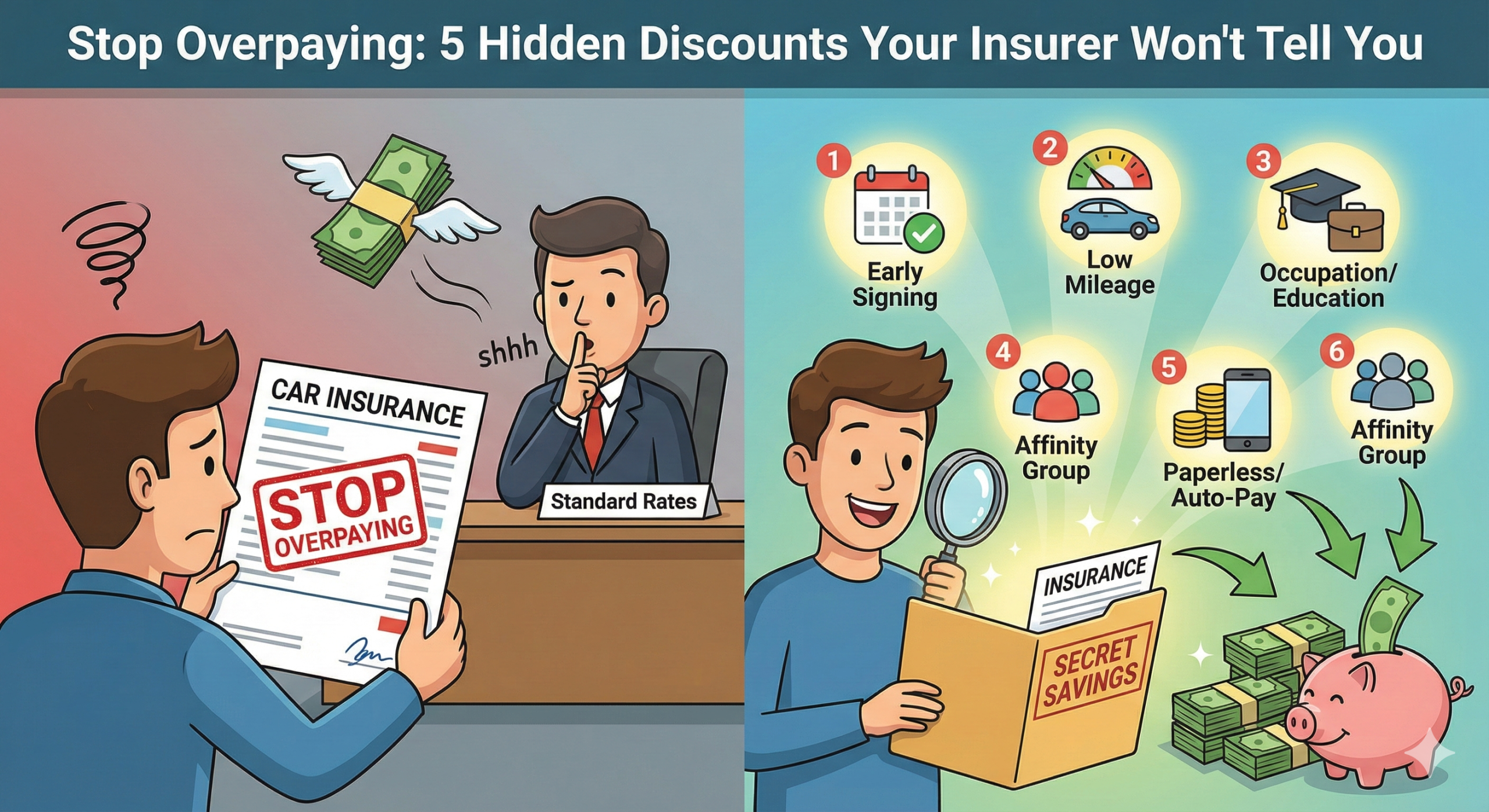
Every six months, millions of drivers experience the same sinking feeling. You open your email or check your mailbox, and there it is: your car insurance renewal notice. Despite maintaining a clean driving record and avoiding accidents, the number at the bottom of the page has somehow crept up. It is frustrating, it feels unfair, and unfortunately, it is becoming the new normal in the current economic climate. But what if I told you that you are likely leaving money on the table simply because you didn’t know the “magic words” to ask your agent?
The truth is, insurance companies are businesses built on risk assessment. They have complex algorithms that determine your rate, and tucked away inside these algorithms are dozens of potential price breaks that aren’t advertised on billboards. These are what industry insiders often call “hidden” discounts. They aren’t truly secret, but they are rarely applied automatically. Unless you actively inquire about them or structure your policy to trigger them, you will miss out.
In this comprehensive guide, we are going to pull back the curtain on the insurance industry. We will explore 5 hidden discounts that can significantly lower your car insurance premium. We will look at the psychology behind why they exist, provide real-world examples of how to get them, and break down the math so you can see the potential savings. It is time to stop overpaying and start driving smarter.
1. The “Advance Shopper” Discount (Early Bird Savings)
One of the most powerful, yet frequently overlooked ways to slash your car insurance bill is simply by watching the calendar. Most drivers wait until the very last minute—often the day their current policy expires—to shop for a new rate. Insurers know this behavior correlates with higher risk. Data suggests that people who wait until the last minute are often less financially stable or more disorganized, which statistically leads to more claims.
Conversely, if you shop for a quote 7 to 14 days before your policy starts, you can trigger an “Advance Purchase” or “Early Shopper” discount. This metric is a strong indicator of responsibility. By simply planning ahead, you signal to the insurer that you are a low-risk client who manages their life effectively. This discount doesn’t require you to change your driving habits; it only requires you to change your shopping habits.
Real-World Scenario: The Last-Minute Scramble vs. The Planner
Imagine two drivers, Mike and Steve. Both are 35 years old with clean records. Mike waits until his policy expires on Friday to call for a new quote. Steve calls two weeks early. Even though their driving history is identical, Steve’s quote is 10% lower. Over a $1,500 annual premium, Steve saves $150 just for making a phone call 14 days sooner than Mike. It is essentially free money for being organized.
For more insights on how timing affects your finances, check out our guide on creating a financial planning calendar.
You can read more about how insurers use credit and timing data at the Insurance Information Institute.
2. The “Occupation and Education” Adjustment
Did you know your job title could be costing—or saving—you money? Many major car insurance providers offer lower rates to drivers in specific professions. This isn’t because they like engineers more than artists; it is purely statistical. Actuarial data shows that certain professions, such as scientists, engineers, teachers, pilots, and first responders, tend to file fewer claims. They may also drive at safer times of the day or possess personality traits associated with caution.
Similarly, your level of education can impact your rate. Drivers with a bachelor’s degree or higher often pay less than those with only a high school diploma. If you have recently graduated or changed careers, your insurer won’t know unless you tell them. Updating your profile from “Student” to “Engineer” or “Nurse” could result in an immediate premium drop.
The Math: How Your Job Title Impacts Rates
Let’s look at the numbers. A study by consumer advocacy groups found that a factory worker might pay up to $100 more per year than a scientist with the exact same driving record. If you have recently been promoted or earned a degree, call your agent. Ask specifically: “Do you offer professional affinity discounts for my occupation?”
Common Eligible Professions:
- Educators and Teachers
- Engineers and Scientists
- Nurses and Medical Professionals
- Police Officers and Firefighters
- Military Personnel (Active and Retired)
To verify if your degree helps, you can cross-reference consumer reports from Consumer Reports regarding insurance pricing fairness.
3. The “Pleasure Use” vs. “Commuter” Reclassification
Since the global shift toward remote work, millions of cars are sitting in driveways gathering dust. Yet, millions of drivers are still paying for “Commuter” usage on their car insurance policies. When you first signed up for insurance, you likely told your agent you drive to work every day. That classification assumes you are on the road during rush hour—the most dangerous time to drive.
If you now work from home, are retired, or simply commute fewer than 3 days a week, you need to request a reclassification to “Pleasure Use” or “Farm Use” (depending on your location). This is different from a low-mileage discount; this is changing the primary purpose of the vehicle in the insurer’s system. “Pleasure” vehicles are statistically less likely to be involved in fender benders because they aren’t fighting 8:00 AM traffic.
Real-World Example: The Remote Worker
Sarah used to commute 20 miles a day into the city. Her premium was $160/month. After transitioning to a fully remote role, she called her insurer. She provided a recent odometer reading and stated she no longer commutes. Her car was reclassified from “Commuter” to “Pleasure Use,” dropping her premium to $125/month. That is a savings of $420 a year just for updating her status.
For tips on maintaining a car that sits idle, read our article on essential vehicle maintenance for low-mileage cars.
Learn more about vehicle use classifications at DMV.org.
4. The “Affinity Group” Membership Discount
This is perhaps the most “hidden” of all discounts because it relies entirely on your affiliations outside of driving. Many car insurance companies have partnerships with thousands of organizations, alumni associations, fraternities, sororities, and credit unions. These represent “group buying power.”
If you are a member of a large organization (like AAA, AARP, or a specific university alumni group), you might be entitled to a group rate that is significantly lower than the standard retail rate. Insurers view members of these groups as more stable and loyal customers. The discount is usually applied as a percentage off the total premium, often ranging from 5% to 15%.
Comparison: Standard vs. Group Rate
Consider a driver named Alex who graduated from a large state university.
Standard Rate: $1,200/year.
With Alumni Discount (8%): $1,104/year.
Savings: $96/year.
The key here is that the insurer will never ask you for a list of every club you belong to. You must check their list of partners or ask, “Are there any professional or organizational discounts available?”
Check if your university or club is on the list by visiting major carrier sites or looking at NerdWallet’s guide to discounts.
5. The “Stacked” Payment Method Discount
Most people focus on the driving aspect of car insurance, but how you pay the bill matters too. Insurers love efficiency and cash flow. Processing paper checks or monthly credit card transactions costs them money in administrative fees. If you can reduce their administrative burden, they will pass the savings back to you.
This “hidden” discount is actually a stack of smaller adjustments. First, enroll in “Paperless Billing” (getting documents via email). This usually saves a small amount, perhaps $50 a year. Second, set up “EFT/Auto-Pay” directly from a bank account rather than a credit card. This saves the insurer credit card processing fees. Finally, as mentioned in previous guides, paying in full is the king of payment discounts.
The Strategy: Stacking for Maximum Effect
By combining these boring administrative tweaks, the savings add up fast.
Paperless: Save $20.
Auto-Pay (EFT): Save $40.
Pay-in-Full: Save 10% ($150).
Total Savings: $210/year.
You aren’t changing your coverage limits; you are just changing the logistics. It is the easiest money you will ever save.
For more on how payment methods affect your credit and savings, see Investopedia’s breakdown of EFTs.
Bonus: Why You Should Audit Your Policy Every 6 Months
The common thread among all these hidden discounts is that they require communication. Your life changes constantly—you move, you change jobs, you pay off debt, your car gets older. Your car insurance policy, however, stays static unless you intervene.
We recommend setting a reminder on your phone for every six months (coinciding with your renewal). Spend 15 minutes reviewing your declarations page. Has your credit score improved? Did you get married? Did you install a new security system in your car? Any of these small life changes could unlock a new tier of pricing.
You can verify your car’s safety features and potential discounts at the National Highway Traffic Safety Administration (NHTSA).
Conclusion
Lowering your car insurance premium doesn’t always mean sacrificing coverage or driving a cheaper car. Often, it just means being a smarter consumer. The “sticker price” of insurance is rarely the final price if you know where to look for the cracks in the system.
From becoming an “Early Shopper” to leveraging your job title and refining how you pay your bill, these 5 hidden discounts can collectively save you hundreds of dollars a year. Do not wait for your insurer to offer them—they likely won’t. Pick up the phone, call your agent today, and ask the right questions. Your bank account will thank you.
Disclaimer: Insurance discounts vary significantly by state and insurance provider. Always consult with a licensed professional to ensure you have adequate protection for your specific needs.
Additional Resources:
J.D. Power Insurance Studies
National Association of Insurance Commissioners
Forbes Advisor: Car Insurance
Bankrate Auto Insurance Guide